

Nationwide's 1% Deposit Mortgage: Who Qualifies and Is It Right for You?
Nationwide's new 1% deposit mortgage lets eligible first-time buyers borrow up to 6x income at 5.99%. See who qualifies, the costs and the risks.

TL;DR
- New launch: On 25 November 2026, Nationwide introduced its Helping Hand 1% Deposit Mortgage to help eligible first-time buyers get onto the property ladder.
- Deposit: You only need to save 1% of the purchase price, with Nationwide lending up to 99% of the property's value.
- Borrowing: Depending on Nationwide's affordability checks, you could borrow up to six times your income.
- Rate: Your interest rate is fixed at 5.99% for five years, and there is no product fee.
- Minimum income: You need to earn at least £30,000 if applying alone or £50,000 between you if applying jointly.
- Property: You can only purchase an existing house. Flats, new builds and listed buildings are not eligible.
- Self-employed: If self-employment is your main source of income, you will not qualify for this mortgage.
- Main risk: Starting with just 1% equity means even a small drop in house prices could leave you owing more than your home is worth.
Wondering whether you could qualify? Speak to a Mortgage Specialist on 020 3011 1986 to explore your options.
Your home may be repossessed if you do not keep up repayments on your mortgage.
 Play video
Trying to save for a deposit while paying rent every month is not easy. Just when you feel you are getting closer to your savings goal, your rent increases or house prices rise, leaving you with even more to save.
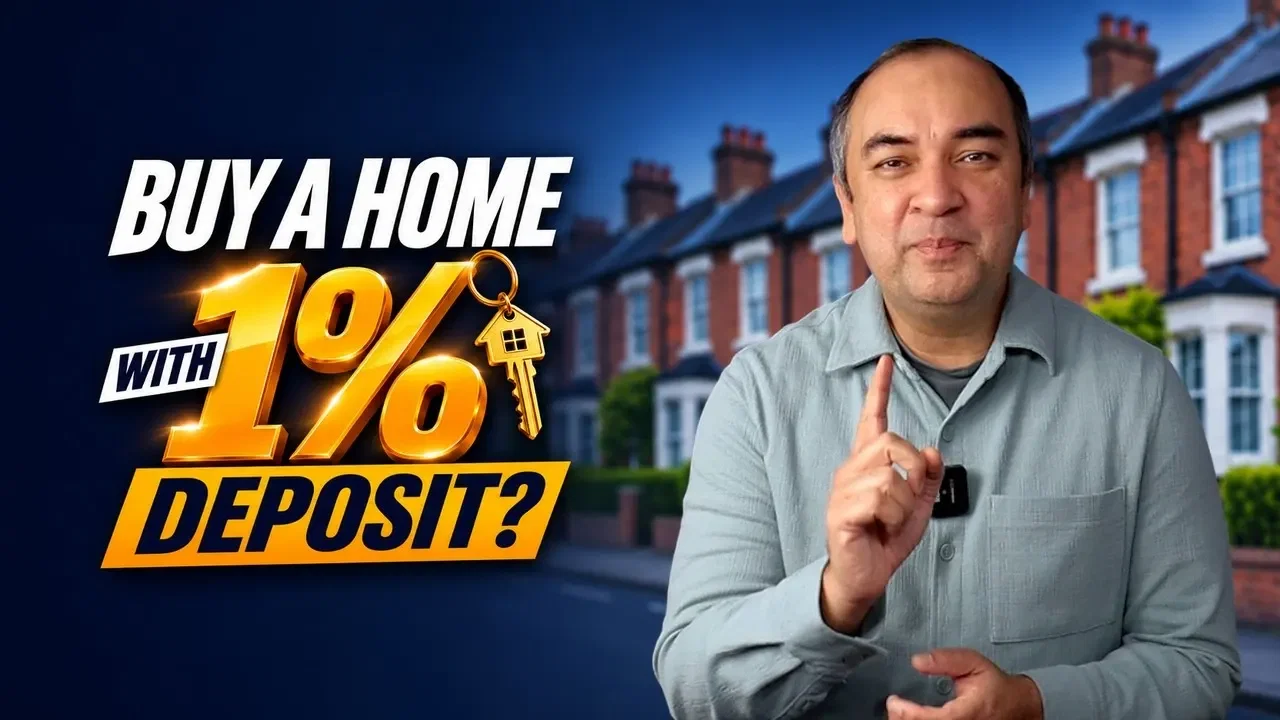
For some first-time buyers, things could be about to change. This week, Nationwide launched a mortgage that allows eligible buyers to purchase a home with just a 1% deposit and potentially borrow up to six times their income.
While this could make getting onto the property ladder easier, it is important to understand that a 1% deposit also carries risks. So, who can apply, how much could your monthly repayments be, and is this mortgage right for you? I will walk you through what you need to know before making that decision.
What Is Nationwide's Helping Hand 1% Deposit Mortgage?
Nationwide's Helping Hand mortgage has been around since April 2021. It allows eligible first-time buyers to borrow up to six times their income and has already helped more than 85,000 first-time buyers.
What makes this new version different is that you can access the same borrowing potential with a deposit of just 1%. Here is what you need to know:
| Feature | Details |
|---|---|
| Minimum deposit | 1% (up to 99% loan to value) |
| Maximum borrowing | Up to six times your income, subject to affordability |
| Interest rate | 5.99% fixed for five years |
| Product fee | None |
| Cashback | £500 on completion |
| Maximum loan | £750,000 |
| Maximum mortgage term | 40 years |
| Gifted deposits | Accepted, subject to criteria |
| How to apply | Through a mortgage broker or a Nationwide mortgage adviser |
Nationwide plans to lend up to £1 billion a year through this mortgage, which it expects will help more than 5,000 additional first-time buyers get onto the property ladder each year.
Why Does a 1% Deposit Make Such a Difference?
The biggest difference is how long you may need to save. Based on Nationwide's estimates for an average first home costing £235,200:
- With a 1% deposit, you would need to save £2,352, which could take around 15 months.
- With a 5% deposit, you would need £11,760, taking approximately five years and nine months to save.
- If you are buying in London, the difference is even greater. Saving a 1% deposit could take around two years, compared with nine years for a 5% deposit.
These estimates are based on saving 5% of average take-home pay each month, assuming house prices stay the same throughout your saving period.
Source: Nationwide press release, 25 November 2026.
Who Qualifies for the 1% Deposit Mortgage?
Before applying, you will need to check whether you meet Nationwide's eligibility requirements:
- You must be a first-time buyer. If you are applying with someone else, they must also be a first-time buyer.
- Your annual income must be at least £30,000 if applying alone or £50,000 combined if applying jointly.
- The property you want to buy must be an existing house.
- Self-employment cannot be your main source of income.
- You must be at least 18 years old and living in the UK.
- You must pass Nationwide's affordability, credit scoring and underwriting checks.
Even if you meet these requirements, approval is not guaranteed. Nationwide carries out enhanced affordability and underwriting checks for this mortgage. You will also need to receive mortgage advice, either through a mortgage broker like us or directly from a Nationwide mortgage adviser.
What Does the 1% Deposit Mortgage Not Cover?
Before you start looking for a property, it is worth knowing what Nationwide will not accept under this mortgage:
- Flats
- New build homes
- Listed buildings
- Leasehold properties with less than 90 years remaining on the lease
- Applicants who rely on self-employment as their main source of income
- Right to Buy, Shared Ownership or other equity schemes
These restrictions are particularly important if you are planning to buy in London or another major city, where many properties suitable for first-time buyers are flats. Similarly, if you are self-employed or have your eye on a new build, this mortgage will not be an option for you. We will explore some alternative mortgage options further down.
How Much Could I Borrow at Six Times My Income?
To give you an idea of how much more you could borrow with Helping Hand, Nationwide compares its higher income multiple with standard borrowing based on 4.5 times your income.
| Income | Without Helping Hand | With Helping Hand |
|---|---|---|
| £30,000 (single applicant) | £135,000 | £180,000 |
| £50,000 (joint applicants) | £225,000 | £300,000 |
Source: Nationwide Helping Hand. These examples assume no other costs affect affordability.
Pay attention to the words "up to". Six times your income is the most you could borrow, but that does not mean you will automatically qualify for that amount. Nationwide will take several things into account:
- Your regular monthly expenses
- Any existing debts, including car finance, loans and credit cards
- Your credit history
- Your ability to keep up with repayments if interest rates rise
As an adviser, one of the first things I look at is your existing financial commitments, because they can make a big difference to how much you can borrow. Lenders consider your regular payments alongside the income multiple. Even if borrowing six times your income looks possible on paper, a £300 monthly car finance payment could reduce that amount.
Here are a few things to keep in mind before applying:
- Credit cards can affect affordability. Even if you clear your balance every month, some lenders may factor in a percentage of your balance or credit limit.
- Nearly repaid finance can still count. Some lenders overlook agreements with only a few payments remaining, while others include them.
- New credit could reduce your borrowing. Taking out a phone contract, loan or buy now, pay later agreement before applying could affect your affordability and may appear on your credit file.
- Small changes could make a difference. Clearing a small loan or credit card balance before applying could help you borrow closer to the amount you need.
Being able to borrow more is not always a good thing. A bigger loan means bigger monthly payments for years. So, the question is not just "how much can I borrow?" It is "how much can I comfortably repay?"
What Would the Monthly Payments Look Like?
Here is an example. Say you buy a £250,000 house with a 1% deposit of £2,500. You borrow £247,500 at 5.99%, fixed for five years.
| Mortgage term | Monthly payment | Balance after five years | Loan to value after five years (if prices stay flat) |
|---|---|---|---|
| 25 years | £1,593 | £222,550 | 89.0% |
| 35 years | £1,410 | £235,355 | 94.1% |
| 40 years | £1,360 | £238,808 | 95.5% |
These figures are for illustration purposes only and are based on a capital repayment mortgage with a fixed interest rate of 5.99% for the first five years. Fees, insurance and other costs are not included.
There are two important points to consider:
- Lower monthly repayments can mean paying more in the long run. If the interest rate remained at 5.99% throughout the mortgage term, choosing a 40-year term over a 25-year term would cost you around £175,000 more overall.
- Your mortgage balance reduces slowly in the first five years. With a 40-year mortgage term, you would still owe around 95.5% of your home's value by the time your fixed rate ends, assuming house prices remain unchanged.
How Does the Rate Compare With a 5% Deposit?
Better than you might expect. According to Moneyfacts, the average five-year fixed rate at 95% loan to value was 6.30% on 25 November 2026. So Nationwide is pricing its 1% deposit mortgage below the market average for a 5% deposit.
To put this into perspective, if you bought a £250,000 house over a 35-year mortgage term with a 5% deposit at 6.30%, your monthly repayments would be around £1,402. That is only £8 less than the 1% deposit option at £1,410. However, having a larger deposit could give you access to rates below the market average.
What Are the Risks of a 1% Deposit Mortgage?
Negative Equity
When you take out a 99% mortgage, you have very little equity in your home. If house prices fall by more than 1% shortly after you buy, you could end up owing more than your property is worth. This is known as negative equity.
Imagine the £250,000 house from our earlier example drops in value by 5%. Your home would now be worth £237,500, but at the start of your mortgage, you would still owe around £247,500.
If you plan to stay in your home and can comfortably keep up with your repayments, negative equity may not cause immediate problems. However, it could make things considerably more difficult when you want to move or remortgage.
Fewer Options When Your Fixed Rate Ends
After five years, you may still owe more than 90% of your home's value. That can mean fewer deals and higher rates when you come to remortgage.
If you do not arrange a new deal before your fixed rate ends, you will move onto Nationwide's Standard Mortgage Rate. According to Nationwide, this currently stands at 6.49% and is set to increase to 6.74% from 1 December 2026.
Early Repayment Charges
Your interest rate is fixed for five years, so if you decide to pay off your mortgage, remortgage or switch to another lender during this period, you may face an early repayment charge.
You can, however, overpay up to 10% of your loan amount each year without incurring a charge. Before committing to the mortgage, check your mortgage illustration so you know exactly what charges could apply.
A Stretched Budget
If you borrow up to six times your income, you may find that there is less money left over each month for everyday expenses. Remember, your deposit is not the only upfront cost of buying a home. You will also need to budget for solicitor fees, surveys and moving costs, as well as any stamp duty that may apply depending on the property's price and location.
Is the 1% Deposit Mortgage Right for You?
It could suit you if:
- You have a stable job and earn above the minimum income requirements.
- You are already paying high rent and could comfortably manage similar monthly mortgage repayments.
- You are looking to buy an existing house rather than a flat or new build.
- You expect to live in the property for at least five years.
- You do not have family members who can help you with a larger deposit.
It may not suit you if:
- There is a chance you will need to move within the next five years.
- You already struggle to find room in your monthly budget.
- Your main income comes from self-employment, or you want to buy a flat or new build.
- You could save a larger deposit within a reasonable time and potentially secure a better interest rate.
From an adviser's point of view, the deposit is rarely the only hurdle. Affordability, your credit file and the type of property you want matter just as much. So, before you start booking viewings, it is worth getting a clear picture of all three.
What Are the Alternatives to a 1% Deposit Mortgage?
If the Nationwide mortgage does not fit, there are other low or no deposit options. Here are some of the main ones:
| Option | Minimum deposit | Key points |
|---|---|---|
| Yorkshire Building Society £5k Deposit Mortgage | £5,000 | First-time buyers only, up to 99% loan to value, properties up to £500,000 |
| Lloyds, Halifax and Bank of Scotland £5k deposit | £5,000 | Up to about 98% loan to value on homes up to £300,000; the deposit must come from your own savings |
| Santander My First Mortgage | £10,000 | Up to 98% loan to value, loans from £190,001 to £500,000; not for flats, new builds or homes in Northern Ireland |
| Skipton Track Record Mortgage | 0% | Based on 12 consecutive months of rent paid within the last 18 months |
| Lloyds Lend a Hand | 0% | A family member puts 10% of the price into a savings account for three years; not for new builds |
| Barclays Family Springboard | 0% | A family member puts 10% of the price into a savings account for five years |
| Your First Home scheme | 2.5% | New builds in England only, with a 20% government equity loan; applications expected from February 2027 |
Lender criteria were checked between 24 and 26 November 2026. Lenders change their products often, so always check the latest terms.
You can read more in our guides to no deposit mortgages in 2026 and the Your First Home scheme.
How WIS Mortgages Can Help
Buying a home with a 1% deposit is a significant financial commitment, and we want to help you make a decision that works for you. Here is how we can help:
- Check whether you meet Nationwide's criteria before you submit a full mortgage application.
- Explore other low deposit options available through the lenders we work with.
- Help you understand what you can comfortably afford each month, taking upfront costs into account.
- Guide you through the paperwork, including any evidence needed for a gifted deposit.
At WIS Mortgages, we are rated 4.9 out of 5 on Trustpilot and are authorised and regulated by the Financial Conduct Authority (FCA number 824411).
Speak to an advisor about your circumstances.
Book a Free Initial AppointmentFrequently Asked Questions
No. The Helping Hand 1% Deposit Mortgage is only available on existing houses. Flats, new build homes and listed buildings are not eligible, and neither are leasehold properties with less than 90 years left on the lease.
Yes. Nationwide accepts gifted deposits on this mortgage, subject to its usual criteria. You will usually need a signed gift letter and proof of where the money came from.
Possibly. Joint applicants need a combined income of at least £50,000. In Nationwide's own example, a couple earning £50,000 between them could borrow up to £300,000, which is six times their combined income. The amount you are offered depends on your outgoings, credit history and Nationwide's affordability checks.
Not if your main income comes from self-employment. If you are employed and also have some self-employed income on the side, Nationwide may consider that second income under its standard self-employed lending policy.
You move onto Nationwide's Standard Mortgage Rate unless you choose a new deal. That rate is 6.49% today and rises to 6.74% from 1 December 2026. You can switch to a new Nationwide deal or remortgage elsewhere, but if you still owe a high percentage of your home's value, your choice of deals may be limited.
Not on average. Moneyfacts data shows the average five-year fixed rate at 95% loan to value was 6.30% on 25 November 2026, so Nationwide's 1% deposit rate sits below the market average for a 5% deposit. Some individual 95% deals may still be cheaper, and a bigger deposit usually gives you access to more lenders and lower rates.
Nationwide estimates that saving a 1% deposit on an average first home (£235,200) would take about 15 months, compared with five years and nine months for a 5% deposit. This assumes you save 5% of average take-home pay each month and house prices stay the same.
The mortgage is available through mortgage brokers and through Nationwide's own mortgage advisers. Every applicant must receive mortgage advice, so you cannot apply on an execution-only basis.
Further Reading
- Nationwide: Helping Hand 1% Deposit Mortgage press release
- Nationwide: Helping Hand mortgages
- MoneyHelper: How much deposit do you need for a mortgage?
- No deposit mortgages UK 2026: do you need to wait to buy your first home?
- Mortgage rates hit 6%: what should first-time buyers do now?
- Fixed vs tracker mortgages: should you track now and fix later?
Thinking about a 1% deposit mortgage? Speak to one of our mortgage advisers on 020 3011 1986.
Your home may be repossessed if you do not keep up repayments on your mortgage.
This article is for general information and guidance only and does not constitute financial advice. Everyone's circumstances are different, so please speak to a qualified mortgage adviser before making any decisions. Figures and forecasts quoted are correct at the time of writing and may change. Information checked on 26 November 2026.
Related reading
 First-Time Buyer MortgagesNo deposit mortgages UK 2026: do you need to wait to buy your first home?
 First-Time Buyer MortgagesThe 5% deposit mortgage scheme: What it means for homebuyers | WIS Mortgages
 First-Time Buyer MortgagesYour First Home Scheme: How the New2.5% Deposit First-Time Buyer Scheme Could Work
Want to see real lender options?
Answer a few quick questions without leaving this page.
Talk it through with an advisor
Your home may be repossessed if you do not keep up repayments on your mortgage.